
This communication shares details on how projects using Gold Standard for the Global Goals will transition to methodologies aligned with the Paris Agreement.
Alignment with the long-term temperature goals of the Paris Agreement is essential for maintaining the environmental integrity and credibility of carbon credits in the evolving global market. This mandatory alignment serves several critical objectives:
- To maximise market viability and manage risk, by ensuring Gold Standard credits remain eligible and valued across voluntary and compliance-linked markets;
- To reinforce integrity and ambition, ensuring credits credibly contribute to raising global ambition over time under the Paris framework; and
- To keep Gold Standard at the forefront of the market by applying the best available science and evolving best practices, as has always guided our work.
Throughout 2025, Gold Standard has developed and published new requirements for methodology development to ensure Gold Standard methodologies are compatible with the Paris Agreement with regards to additionality, baseline setting, leakage and data quality.
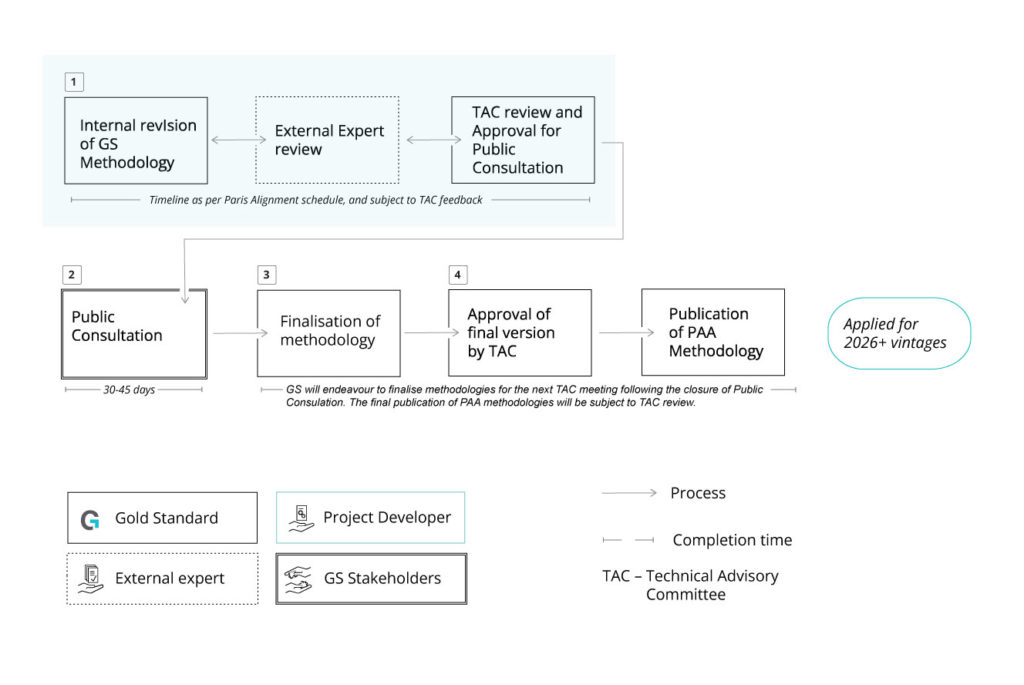
The Secretariat is currently in the process of reviewing and updating all Gold Standard methodologies to align with these requirements. When ready, each updated methodology will be posted for a 30-day public consultation before seeking final Technical Advisory Committee (TAC) approval. The proposed schedule for methodology review and alignment is available online. Those methodologies that are applied most often or have the most impact have been prioritised.
Paris Agreement Article 6 Alignment schedule
To manage the systematic transition of all GS4GG methodologies and active projects to Paris Agreement alignment by the mandated 2026 vintage deadline, an indicative schedule is proposed.
Key Milestones Summary
| Date | Milestone |
| Q4 2025 | Publication of formal Requirements and Guidance documents |
| Q4 2025 | VVB mandatory training commenced and will continue throughout 2026. |
| Q4 2025 | Registry system updates implemented and operational. |
| 01 Jan 2026 | Vintage Mandate Effective: All 2026+ credits must be A6 aligned. |
| 30 June 2026 | Sunset Date: Final deadline for new submissions under old methodologies. |
Indicative schedule for the revision of methodologies
Development and review of revised methodologies is proposed to be completed as per the following schedule, in alignment with necessary Technical Advisory Committee (TAC) approval and publication.
Methodologies are prioritised based on usage. In order to leverage existing assessments, Gold Standard is actively following the UNFCCC process to republish CDM methodologies under Paris Agreement Crediting Mechanism (PACM). If there are significant delays with PACM publication, Gold Standard will include and update any relevant methodologies within its workplan.
Last update April 2026
Next Update Q3 2026
All Gold Standard methodologies to be PA aligned by the end of 2026.
Alongside the Paris Agreement Article 6 Alignment Schedule,Gold Standard is seeking feedback on the following tools and guidance.
All consultations close 5 November 2025.
- GS4GG Paris Agreement Alignment Documentation To support projects in the mandatory shift to Paris Agreement aligned methodologies, Gold Standard has developed Requirements, Guidance, and FAQs. Although the core Alignment Requirements, including key dates, are established based on fundamental needs for Paris Agreement compliance and are not subject to revision, we are seeking feedback on the clarity of procedures, the effectiveness of the guidance and coverage of FAQs.
In addition, we have launched two further consultations for tools that have been designed to support project developers and help make the alignment process as simple and smooth as possible
- Methodology tool – downward adjustment This
- Methodology tool – common practice tool This methodological tool establishes a standardised, quantitative, and simplified procedure for conducting common practice analysis within the GS4GG framework. Its primary function is to provide a systematic approach for evaluating the market penetration of a proposed technology, measure, or practice as part of the overall additionality assessment.